


Earharts Flight Into Yesterday - The Facts Without The Fiction
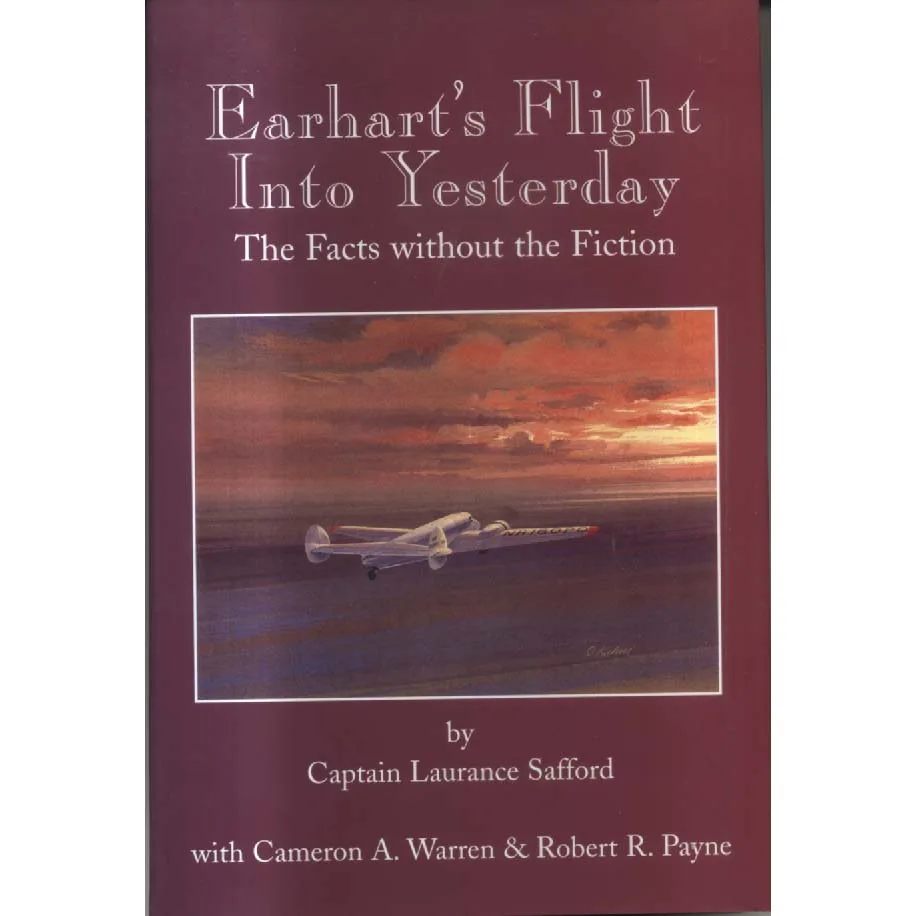
Publisher: Paladwr Press
Format: Hardback
ISBN: 1888962208
Earhart’s Flight into Yesterday approaches the disappearance of Amelia Earhart with the radical proposal that the evidence should be examined before everybody invents another secret island, Japanese prison cell or international espionage operation.
On 2 July 1937, Earhart and her navigator Fred Noonan departed Lae, New Guinea, in their Lockheed Electra on the most difficult stage of their attempted flight around the world. Their destination was Howland Island, a tiny speck in the central Pacific that could easily be misplaced beneath a coffee stain on an ordinary map. The plan required them to cross roughly 2,500 miles of ocean and locate this extremely small target using celestial navigation, radio direction finding and the optimistic assumption that every piece of equipment would cooperate.
Waiting near Howland was the US Coast Guard cutter Itasca, transmitting signals, generating smoke and attempting to establish radio contact. Earhart’s voice was received with increasing strength, suggesting that the Electra was nearby, but communication remained largely one-way. Earhart could apparently hear little or nothing from the ship, the ship could not obtain a reliable bearing on her, and two groups of intelligent people equipped with radios spent the final hours talking past one another across a very large ocean.
Captain Laurance F. Safford reconstructs the flight through radio logs, navigation calculations, messages, charts and search records. One of the pioneers of American naval cryptology, Safford brought to the mystery a professional suspicion of vague recollection and a fondness for evidence that could be timed, plotted and checked. His conclusion was brutally concise: poor planning followed by worse execution.
Rather than proposing that Earhart was captured by the Japanese, employed as a secret agent or quietly returned to America under another identity, the book argues that she and Noonan failed to locate Howland, exhausted their fuel and went down at sea. It is a distressingly ordinary ending to an extraordinary adventure, which may explain why generations of enthusiasts have preferred theories involving spies, coded messages and suspicious photographs of people who look slightly like somebody else from a considerable distance.
The title’s promise of “the facts without the fiction” is supported by a formidable collection of technical material. The book examines the Electra’s radio equipment, frequencies, antennas, direction-finding arrangements, fuel, weather, navigation and the subsequent search. Tables, maps, photographs and reconstructed communications allow the reader to follow the final flight almost minute by minute, although possessing this information in advance would undoubtedly have been more useful to the people aboard the aircraft.
Safford began his investigation around 1970 but died in 1973 before his manuscript could be published. Cameron A. Warren and Robert R. Payne later recovered, completed and updated the work, bringing together decades of research in this 2003 Paladwr Press edition. Their contribution preserves Safford’s analysis while adding further material to a case that has continued to attract new evidence, old rumours and occasional pieces of coral confidently identified as aircraft.
This is not a conventional biography of Earhart and does not spend hundreds of pages tracing her childhood, celebrity or marriage. It is a concentrated investigation of the last flight: what was planned, what was transmitted, what went wrong and what can reasonably be concluded. Readers seeking romance will still find courage and tragedy, but the romance is accompanied by frequency tables and an increasingly ominous fuel calculation.
A fascinating book for readers interested in Amelia Earhart, aviation history, navigation, radio communications and famous mysteries examined without first inviting the conspiracy theories to dinner. It may not end the argument—nothing has yet achieved that—but it provides enough documented fact to make future speculation work considerably harder.
This copy is in Good condition, showing ordinary signs of previous ownership but remaining sound, complete and safely accounted for. Unlike the Electra, its present position is known and its route to the buyer will include tracking wherever available. Sold by Crappy Old Books, where facts are preferred to fiction except, naturally, in the fiction department.
Keep browsing: See more History books Other books by Laurance Safford
